



EVIDENCE, CLEARLY SOURCED
Do Nasal Strips Work for Snoring? What the Research Says
Research Dating Back to 1997
What the Studies Actually Show
Research on nasal strips and snoring goes back to 1997. Research suggests nasal strips are most likely to help when snoring is linked to a blocked or narrow nose rather than the throat.
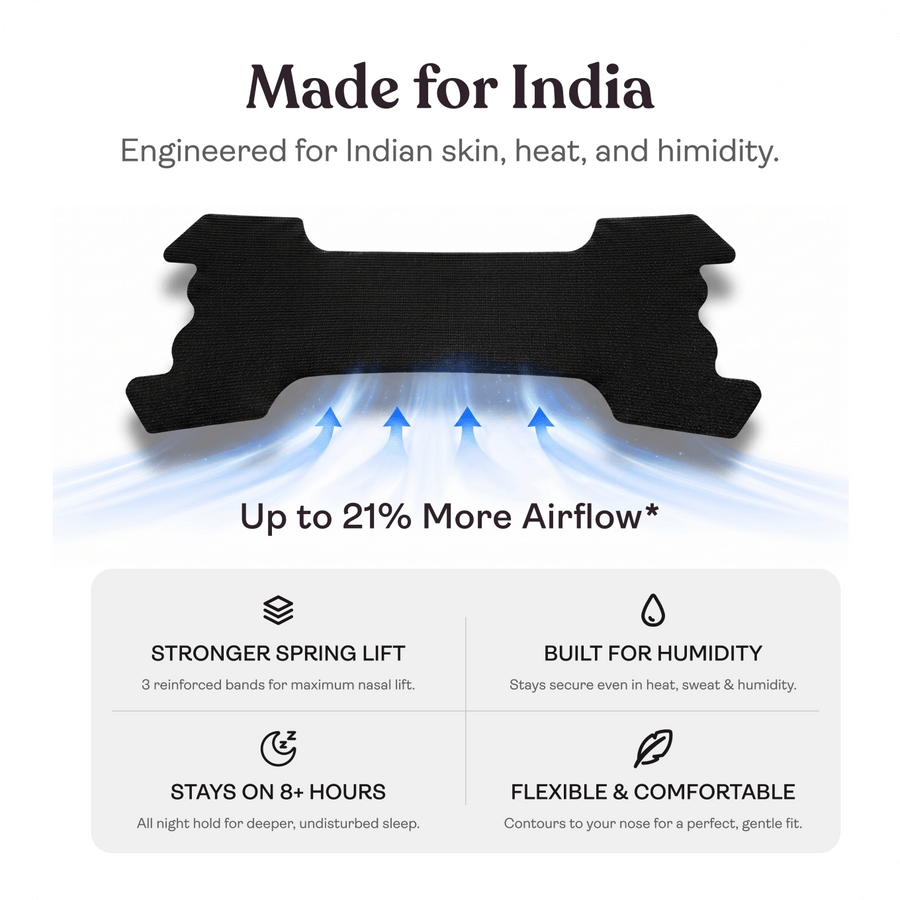
21%[1]
More nasal airflow
Per 10% increase in nasal valve width
Per 10% increase in nasal valve width
52%[2]
Reported less snoring
Partner-rated after 14 nights in a small open-label study
Partner-rated after 14 nights in a small open-label study
17 studies[6]
496 participants reviewed
Benefits appear most relevant for mild symptoms or nasal congestion
Benefits appear most relevant for mild symptoms or nasal congestion
The strongest and most consistent evidence is for snorers whose main issue is nasal congestion. For moderate-to-severe sleep apnea, the research does not support nasal strips as a standalone fix.
*Individual results vary. Nasal strips address nasal-based snoring; they are not a treatment for diagnosed obstructive sleep apnea.
- Camacho et al. (2016), Nasal Dilators for Snoring & OSA: Systematic Review & Meta-Analysis, Pulmonary Medicine. pmc.ncbi.nlm.nih.gov/articles/PMC5187471
- Ulfberg & Fenton (1997), Effect of Breathe Right nasal strip on snoring, Rhinology. pubmed.ncbi.nlm.nih.gov/9299650
- Gelardi et al. (2019), Internal and external nasal dilator in patients who snore, Acta Biomedica. pubmed.ncbi.nlm.nih.gov/30715031
- Schenkel et al. (2018) & Noss et al. (2019), Advances in Therapy. pmc.ncbi.nlm.nih.gov/articles/PMC6109978 & doi.org/10.1007/s12325-019-01005-5
- Systematic Review, Clinical Effectiveness of Nasal Dilators in Sleep-Disordered Breathing (data through Jan 2024). pmc.ncbi.nlm.nih.gov/articles/PMC12761343
- Case Study, Enticare ENT (Nov 2025). enticare.com/2025/11/06/case-study...